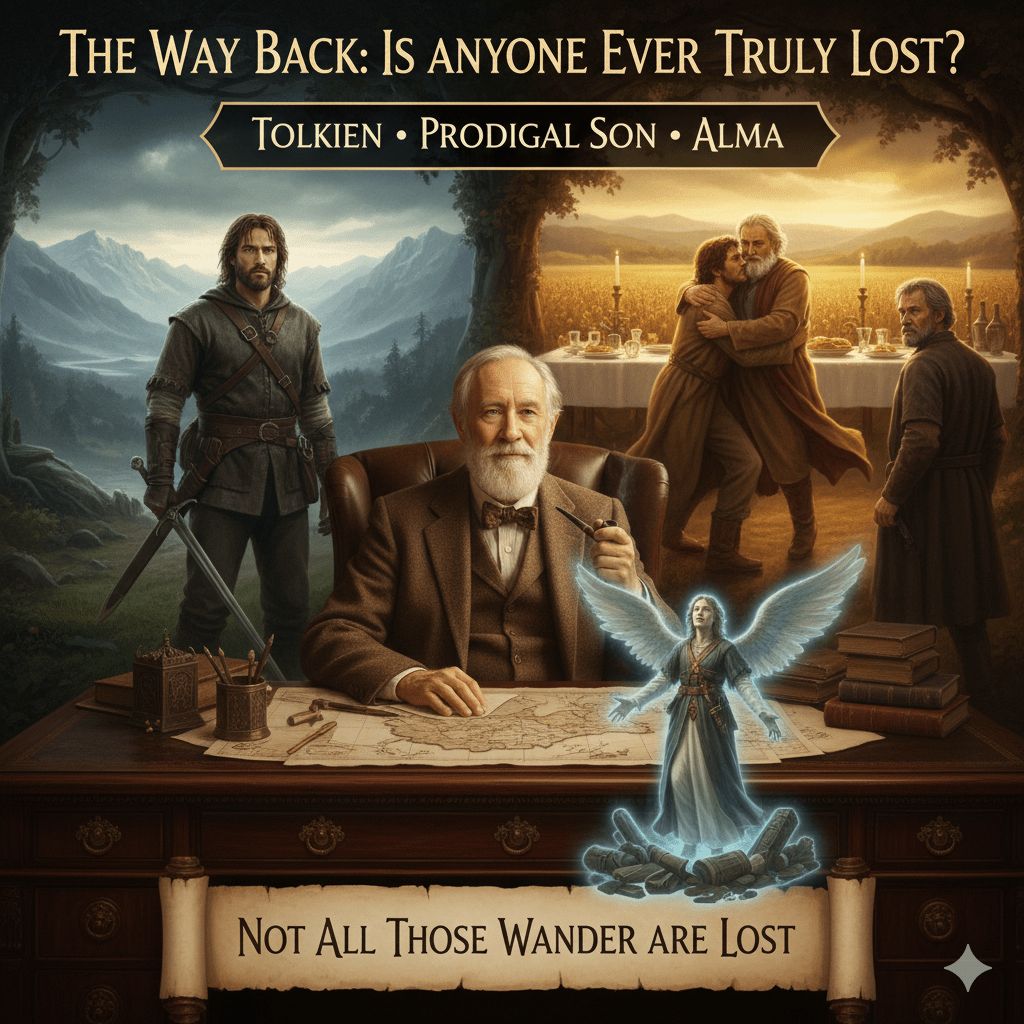
by Jared Harding Wilson
We often see the quote “Not all those who wander are lost” on travel posters and journals. But what about those who aren’t wandering to find scenery? What about those who wander into the dark—into rebellion, shame, or hurting others?
I love a good redemption story!!! But “labelists” (those who choose to see someone by how they look or by something in their past) don’t believe in redemption! Today, we explore the intersection of Middle-earth, the New Testament, and the Book of Mormon to ask: Is anyone truly beyond redemption?
1. The Context: Tolkien’s “Riddle of Strider”
Before he was a King, J.R.R. Tolkien’s Aragorn lived as a weathered “ranger” known only as Strider. Tolkien, a devout Catholic and Oxford professor, wove this famous line into a poem delivered via letter from Gandalf the Grey to a skeptical Frodo Baggins and his fellow Hobbits. While the Hobbits initially feared this ragged traveler at the Prancing Inn, Gandalf’s riddle served as a divine credential, revealing that the “wandering” Strider was actually the rightful heir to the throne. This moment perfectly illustrates Tolkien’s belief that even a life spent in the shadows can be part of a glorious, providential preparation.
Aragorn’s wandering wasn’t aimless; it was a decades-long preparation in the wilderness. To the judgmental eye, he looked like a vagabond in a dirty cloak. But Tolkien used this to show that outward appearances—and even years spent in the shadows—do not define a person’s true identity.
2. The Spent Inheritance: The Prodigal Son
In the New Testament (Luke 15), the younger son doesn’t just wander; he runs. He burns his life down in “riotous living.” When he returns, the father’s reaction is the ultimate answer to the question of redemption: He runs to him.
However, the Elder Brother provides a cautionary tale about the human heart. He refuses to enter the feast, shunning his brother, and immediately labels his brother a “sex offender,” specifically accusing him of wasting money on harlots. By focusing on the “sins of the flesh,” the Elder Brother tries to fix a permanent, shameful label on a person who has already repented. He wants his brother to be defined by his worst mistake forever.
3. The Rebel Leader: Alma the Younger
In the Book of Mormon, Alma the Younger was actively trying to “destroy the church.” He wasn’t just a passive wanderer; he was a high-profile antagonist. If anyone seemed “unredeemable” to the people of his time, it was him. Yet, after a soul-shaking wake-up call, he turned his life around entirely.
How They Made Amends: The Road to Restoration
True redemption isn’t just saying “sorry”; it’s the work that follows. Here is how each man repaired the path behind them:
• Aragorn: He spent years in the “unwatched” corners of the world, protecting the very people (like the Hobbits) who often looked down on him. He turned his wandering into a shield for the innocent.
• The Prodigal Son: He didn’t return asking for his old status. He came back saying, “Make me as one of thy hired servants.” He was willing to do the lowliest work to prove his heart had changed, trading his pride for a shovel.
• Alma the Younger: He spent the remainder of his life “laboring without ceasing” to bring others to the same peace he found. He faced mockery and physical suffering to try and repair the spiritual damage he had caused in his youth.
Is there something so horrible you can never do good again?
The world—represented by the “Elder Brother”—specializes in labels. The Elder Brother wanted his sibling to be a “sinner” forever because it made him feel superior. But these stories argue that who you were is not who you are. Redemption isn’t just about being “forgiven”; it’s about what you do with the “rest of your life.” The Father in the parable didn’t wait for the son to reach the front door or finish a list of chores; he literally ran to his son the moment he saw him turning back.
The takeaway: If you feel like you’ve wandered too far, remember that the distance you traveled away is irrelevant the moment you turn around. Not all who wander are lost—some are just on the long road home.
Deep Dive Trivia
• The Accusation: In the original Greek of the New Testament, the Elder Brother’s accusation is particularly cutting. He uses the word porneia to ensure the Father feels disgusted, yet the Father refuses to even address the gossip—he only celebrates that his son is “alive again.”
• Tolkien’s “Eucatastrophe”: Tolkien coined this word to describe a “sudden joyous turn” in a story where all seems lost. Tolkien was a devout Catholic. He described The Lord of the Rings as a “fundamentally religious and Catholic work.” His concept of “Eucatastrophe”—also, the sudden, miraculous turn from certain doom to victory—is the literary version of the Prodigal Son’s return. He believed the Resurrection was the greatest “Eucatastrophe” in history—the ultimate proof that no situation is beyond hope.
I’d love to hear your thoughts in the comments below:
1. Which “wanderer” do you relate to most? Is it the hidden ranger, the returning son, or the reformed rebel?
2. How do we handle the “Elder Brother” in our own lives? Is it harder to forgive ourselves, or to stop labeling others by their past mistakes?
3. Can someone ever truly be “too far gone”? What helps you believe in the possibility of a “sudden joyous turn”?
Digital image created by Jared Harding Wilson. All rights reserved.
Discover more from Hike Stars On Earth
Subscribe to get the latest posts sent to your email.

No one is beyond the reach of God’s grace. I truly believe that 🙂
LikeLiked by 1 person
Thanks! 🙏 I totally agree! 👍
LikeLike
You just have to say: Manasseh, 2 Chron, ch 33. If he was redeemable, there’s hope for us all 💗
LikeLiked by 2 people
Manasseh’s story is such a powerful addition to this conversation! It’s a beautiful redemption story because it shows that even after a lifetime of ‘wandering’ into evil, a heart-change is always possible. The fact that God restored his kingdom and Manasseh stayed faithful for the rest of his days is such a testament to grace. Thanks for pointing to that chapter—it fits this theme perfectly! Have a blessed day! 💛
LikeLike