by Jared Harding Wilson
⚠️ WARNING: SPOILERS AHEAD ⚠️
If you haven’t seen HAMNET yet, pause here. Go see the film first. Sit with it. Bookmark this post and come back when you’re ready. This is a story that deserves to be experienced before it’s explained.
*********************
Last night, my wife Sarah and I went to see HAMNET, and when the credits rolled, neither of us moved.
I stayed seated longer than usual—not because I was tired, but because I was afraid. Afraid that if I stood up too quickly, the fragile, sacred mood of the theater would break. Afraid the spirit of the film—the shared stillness, the collective breath—would dissipate the moment my feet touched the floor.
I wasn’t alone.
As we eventually made our way out, I noticed others lingering too. Quiet conversations. Long pauses. People standing with friends and family, still processing. Some wiped their eyes. Some simply stared ahead. No one rushed. This is what a powerful story can do. It changes hearts. It heals. It connects us—to memory, to loss, and to one another.
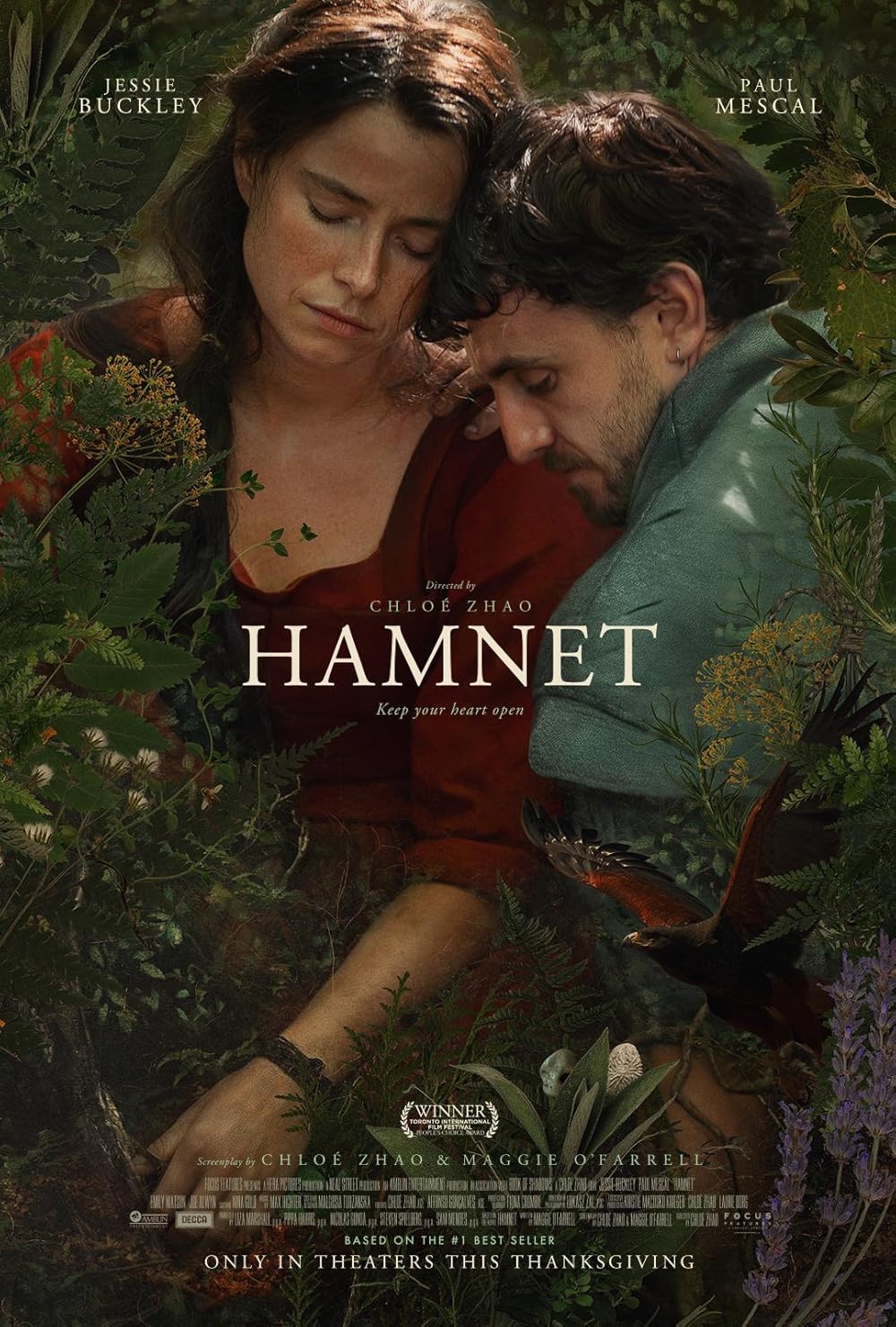
Before going any further, it’s important to note that HAMNET is an adaptation of the 2020 novel Hamnet by Maggie O’Farrell. After seeing this film, that book immediately moved to the top of my reading list.
I went into the movie expecting a story primarily about William Shakespeare. And yes, he is there. But the true heart of HAMNET belongs to Agnes, his wife.
This is not another story centered on a famous man. It is a story about marriage, motherhood, grief, and the quiet endurance of a woman whose life profoundly shaped what came after.
Shakespeare’s wife is most commonly known as Anne Hathaway, yet in this film she is called Agnes. Historically, both names appear in records. In Elizabethan England, names such as Agnes, Anne, and even Elissa were often used interchangeably—variations of the same name.
In her father’s will, she is listed specifically as Agnes, and she is left a sum of money. Even that small historical detail feels significant—evidence that she was named, seen, and remembered in her own right.
The film does not romanticize the era. It shows the dangers of childbirth, the weight of raising children, the cruelty of gossip, and the narrow spaces women were allowed to occupy. And yet—despite social pressure and disapproval—Will chooses Agnes.
There is a moment when Agnes speaks to her brother, who must decide whether to approve the marriage. She says something close to:
“He sees me as I am, not as I ought to be.”
That line stopped me.
I looked at Sarah and felt it immediately. To be seen—not as who the world expects you to be, but as who you truly are—is one of the deepest forms of love.
At the very beginning of the film, a quote explains that “Hamnet” is another way of saying “Hamlet.” The play is named after Shakespeare’s son.
Let that sink in.
The loss of Hamnet is sudden, painful, and devastating. And this is where the film became intensely personal for me.
I have known terrible loss.
Years ago, that loss brought me to the very edge of ending my own life. I’ve written before about my brother, who did die by suicide. What I didn’t write ✍️ about in that blog post was my own brush with death; almost committing suicide myself. When I watched William Shakespeare stand at the precipice, staring into the abyss after his son’s death, it felt hauntingly familiar.
In that moment, he begins to speak words we now know by heart:
“To be, or not to be—that is the question…”
Hearing those words not as poetry, but as grief given language, took my breath away.
This film asks the questions so many of us carry:
How do you go on after great loss?
How do you find hope again?
How do you see light when everything feels dark?
I have wrestled with those questions throughout my life.
One of the film’s quiet triumphs is restraint. You don’t hear the name William Shakespeare spoken aloud until nearly the very end—spoken simply by his brother-in-law. The story never allows fame to eclipse humanity.
Agnes never goes to London. She never sees one of his plays—until the final moments.
William owns New Place in Stratford-upon-Avon, once the largest house in town. The house itself no longer exists, but its footings remain, and the site is open to visitors—Sarah has been there herself.
William Shakespeare is buried nearby at Holy Trinity Church, about 0.4 miles from where New Place once stood. He lies beside Agnes, their daughter Susanna, and Susanna’s husband John Hall. Above his grave is a short verse Shakespeare himself is believed to have written—a warning or curse asking that his bones not be disturbed, and a blessing on those who let them rest in peace.
Yet in London, where William writes, he lives in near isolation—small rooms, sparse surroundings, grief pressing in from all sides.
Something my wife pointed out when we got home brought the entire film into focus for me.
Before Agnes and William are married, there is a tender scene where she asks him why he doesn’t simply talk with her. He admits that he struggles to talk with people—anyone. So Agnes gently asks him to do something else instead. She asks him to tell her a story. And he does. And in that moment, they connect. Deeply. It’s palpable.
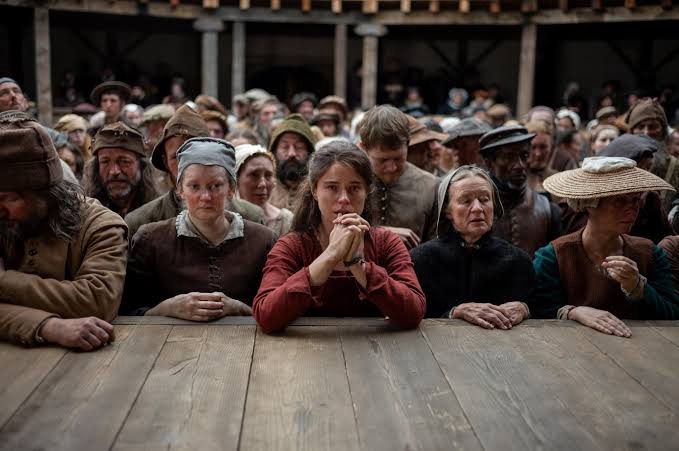
By the end of the film, after the death of their son, they haven’t spoken in months. Grief has hollowed out their marriage. Words have failed them completely. And then—at the Globe Theatre—Agnes sees the story. William’s story. Their story. No words are spoken as William looks at her from beside the stage, but they see each other. Just as they did in the beginning. Once again, it is the story that speaks when words cannot.

And then comes the final scene at the Globe Theatre.
During a performance of Hamlet, Agnes hears her son’s name spoken aloud. She cries out in anguish. But as Hamlet—her son, grown before her eyes—lies dying of poison on stage, she reaches out. She holds his hand. She is given something no grieving parent ever truly receives: a glimpse of who her child might have become.
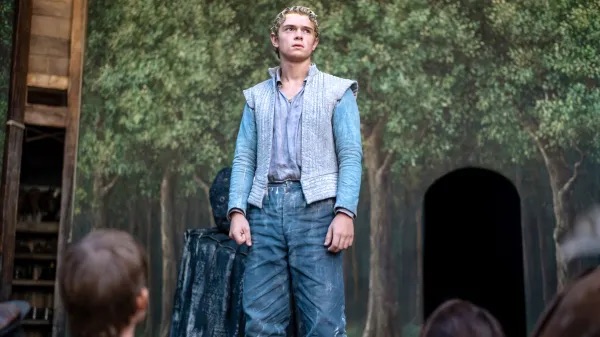
The moment deepens when you learn that the actor who plays Hamlet onstage, Noah Jupe, is the older brother of Jacobi Jupe, who plays Hamnet. That real sibling bond adds another layer of emotional truth to the scene.
Then something extraordinary happens.
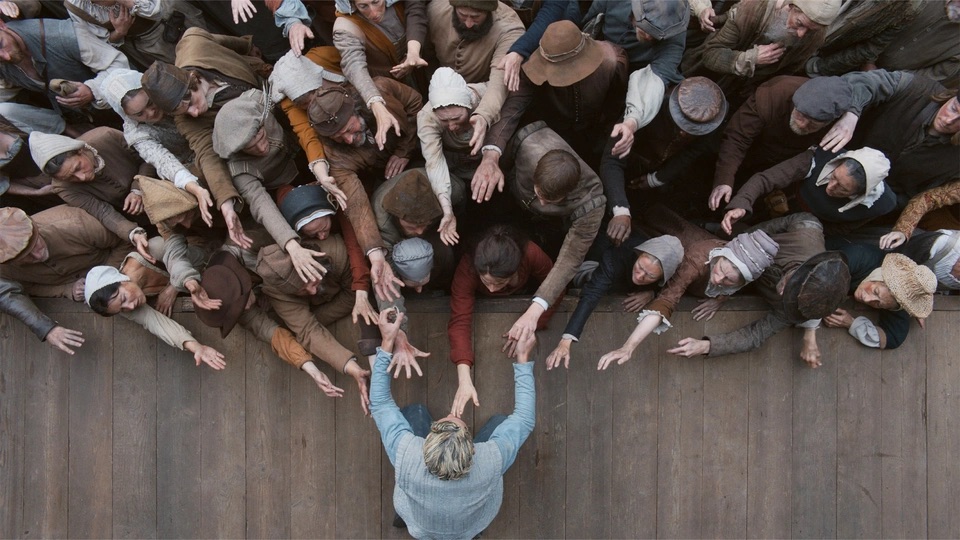
The groundlings—those standing on the floor of the Globe—and the wealthy patrons seated in the upper boxes all reach out toward that dying boy. Everyone. Rich and poor alike. A nation grieving together after plague had taken so many lives.
In that moment, grief becomes communal. Shared. Human.
I am still grieving the losses in my life. Tears still fall. Not a day goes by that I don’t think of them. But HAMNET reminded me that stories can carry our pain—and sometimes, transform it into connection.
If you haven’t seen HAMNET yet—even after reading this—I still invite you to go. Sit with it. Let it move you. Let it linger.
Some stories don’t just entertain.
They remind us we’re not alone.
💬 Questions for You
- Has a story ever helped you process grief or loss?
- How do you think art gives voice to emotions we struggle to name?
I’d love to hear your thoughts in the comments.
Discover more from Hike Stars On Earth
Subscribe to get the latest posts sent to your email.

Wow – sounds like a movie I’d love to see. I haven’t read all of your post – don’t want to know all, yet. Hoping to see it soon.
LikeLiked by 1 person
Carolyn, it was amazing! It’s one of the better movies I’ve seen in a long time actually! You’ll probably want to take a whole tissue box with you though! Yes, if you decide to see it, I would love your feedback on the rest of my post afterwards! 🙏
LikeLiked by 1 person
It will be my pleasure. Thanks for the heads up! 🙏
LikeLiked by 1 person
👍😇
LikeLiked by 1 person
I know you recommended not to read this post until after seeing the movie, but I’m one of those who reads the end of the book first, so I couldn’t resist. And now! I want to see this movie, and I want to see it in the theater. Great review.
LikeLiked by 1 person
Funnn! 🤩 I love it, and yes! It’s a wonderful film! 🎥
LikeLike
Thank you for sharing more than a movie review, but a deeply moving message.
LikeLiked by 1 person
That film 🎥 tugged at my heart-strings and literally had me in tears 😭 feeling feelings powerfully with the storytelling. I’m so glad you liked the post! And thanks for the kind words! 🙏 😊
LikeLiked by 1 person
I’ve enjoyed Shakespeare’s plays since junior high when I first was introduced to works when my drama teacher cast me as Juliet. Although two of my favorites was Taming of the shrew and Othello.
LikeLiked by 1 person
That is thoroughly awesome!!! My wife made a production of Taming set in the 60s—super fun! 🤩 And she has acted in a number of other Shakespeare plays like you! You are a rockstar! 🎭
LikeLiked by 1 person